
Expressive Arts Therapy
You don't have to be an artist. You just have to be willing to make a little mess! Healing that happens in colour, texture, and the thing you didn't know you needed to make.
about approach
What is Expressive Arts Therapy?
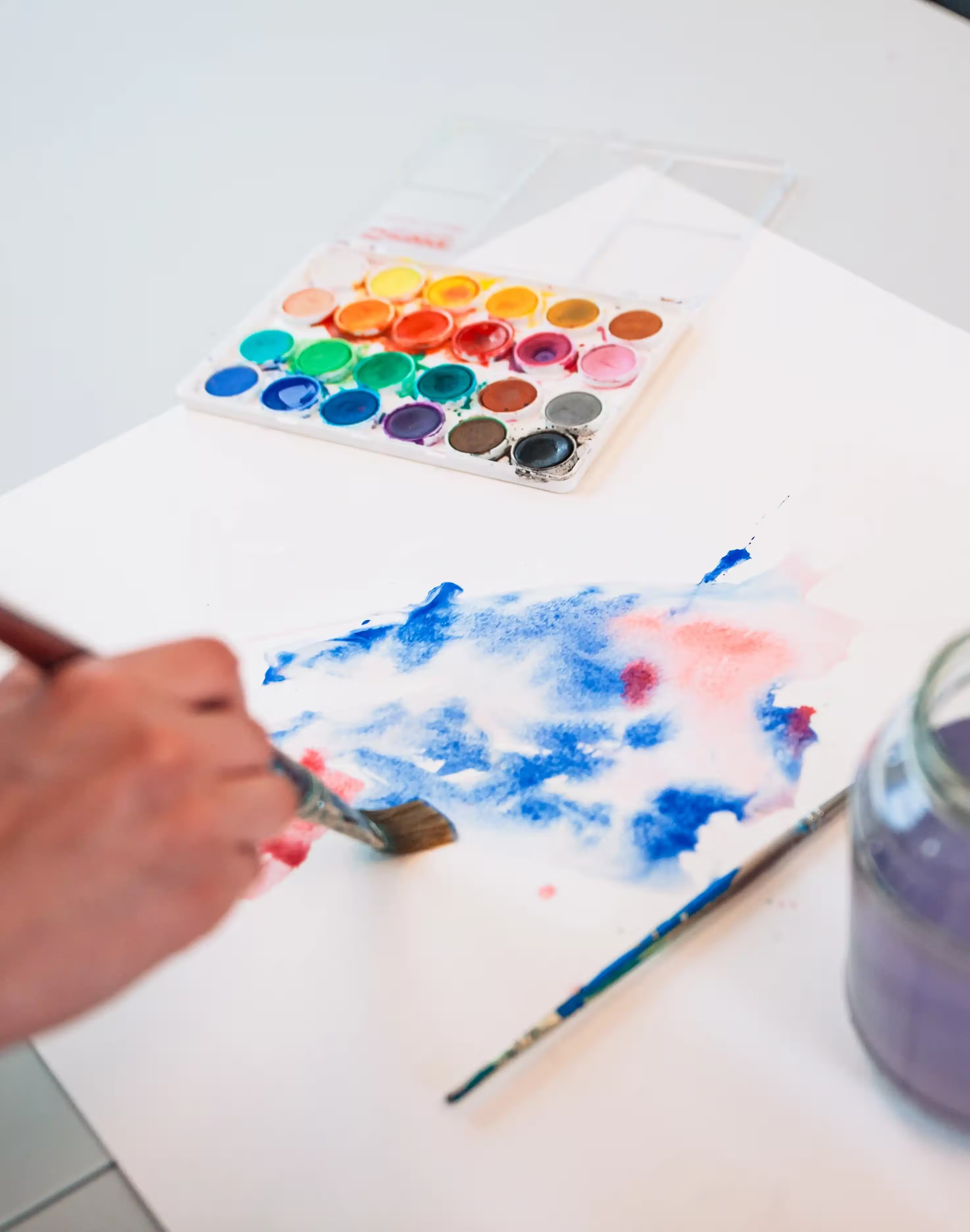
Art therapy is a distinct mental health profession that integrates the creative process of art-making with applied psychological theory and clinical practice, facilitated within a therapeutic relationship. Practised by trained clinicians with graduate-level education in both art and psychology, art therapy is far more than creative expression for its own sake - it is a clinically intentional process in which the act of making, and the meaning that emerges from it, become powerful vehicles for healing, self-discovery, and psychological growth. Working with materials like drawing, painting, collage, clay, and mixed media, clients are invited to express what often cannot be accessed through language alone - and to discover, within the creative process itself, things they did not yet have words for.
What makes art therapy neurobiologically compelling is rooted in how trauma and emotional pain are actually stored. When the brain experiences overwhelming stress, the areas responsible for language and rational thought frequently go offline, which is precisely why so many people find that words run out long before the feeling does. Art therapy bypasses this bottleneck entirely. Visual and sensory creative expression engages the brain's emotional and sensory processing centres simultaneously, activating neural networks associated with memory, meaning-making, and self-regulation in ways that talk-based approaches alone cannot reach. Research has shown that art therapy facilitates healing through neurological reconfiguration of the brain's core processing networks, creating real, lasting change at the level of the nervous system, not just the thinking mind.
Why you might be here
When Words Run Out, Something Else Has to Speak
Maybe you've sat in therapy and done your best - found the words, told the story, understood the connections - and yet something still hasn't shifted. Or perhaps you've never quite been able to find the words in the first place; the experience sits somewhere in your body or your imagination, vivid and present, but stubbornly resistant to language. You might be someone who has always processed the world more through image, sensation, and feeling than through linear thought, and the idea of yet another conversation about what happened sounds more exhausting than healing. Or maybe you simply want something different. Something that surprises you. Something that meets you somewhere other than your head.
Art therapy is particularly well-suited for anyone whose experience has outgrown what talking can hold. This includes people navigating trauma, those whose experiences are more sensory than narrative, those carrying grief or loss that feels too large and shapeless for sentences, people who struggle with emotional articulation or find verbal processing activating rather than relieving, and those who simply feel called toward a more creative, embodied way of working. You do not need any artistic background, skill, or confidence. The focus of art therapy is never the quality of what you make - it is entirely on the process of making it, and what that process opens up.
Unconventional by Choice, Exceptional by Design
Our clinicians combine specialized expertise with intentionally unconventional, innovative methods to craft care that is deeply personal and never one-size-fits-all.We don't just talk about it
Our experiential, integrative treatment models address trauma and a wide range of concerns at their root.Trusted by Over 3,500 Clients and Counting
Our track record reflects thousands of individuals, couples, and families who have found meaningful healing with our team.Rooted in Values, Driven by Relationship
We believe values-based leadership creates values-based care. That relational philosophy shapes every interaction you have with our team, and you'll feel it.
Access to emotional material that language has not been able to reach - expressed, witnessed, and worked with in a new way
Relief from trauma symptoms stored somatically and sensorially, through a modality that works at exactly that level
Meaningful insight and self-understanding that arrived not through analysis, but through the surprise of the creative process

A more compassionate and curious relationship with their own inner world - accessed through image, symbol, and metaphor

Reduced anxiety and emotional overwhelm through the regulating, grounding effects of focused, intentional creative engagement

New language (not just verbal, but visual and symbolic) for experiences previously too shapeless or too painful to name
A tangible, physical artifact that witnessed and held their experience - something you made that carries meaning in ways words often can't

Greater self-expression and confidence in accessing and communicating their inner world, inside and outside of the therapy room
A genuinely different experience of therapy, one that surprises you, moves you, and opens something you didn't know was waiting
Why choose Providence Therapy
years in business
clients served
modalitie options
neurotherapy options
how therapy helps
Making Meaning, Not Masterpieces: How Art Therapy at Providence Helps.
Art therapy has an expanding and genuinely exciting evidence base, with research supporting its effectiveness for trauma and PTSD, anxiety, depression, grief, and much more, across a wide range of populations, including veterans, trauma survivors, and adults navigating complex mental health presentations. Studies have demonstrated that art-making produces neuroplastic changes in the brain's emotional, sensory, and frontal circuits - and that visual creative expression can access and process traumatic material encoded in ways that verbal approaches cannot reach. But beyond what the research shows, what clients consistently report is something harder to measure and equally important: a felt sense of relief, of something having moved, of being understood in a new way; not by someone else, but by themselves.
At Providence, art therapy is offered as a clinically integrated, trauma-informed practice; not simply a wellness activity or a creative break from the "real" work ( while it can be that too!). Art therapy acts as a precise and purposeful clinical tool woven into our broader experiential, trauma-focused framework. Our approach is shaped by an understanding that art therapy works differently for different people, and that how materials, invitations, and the creative process are offered matters enormously. Some clients work with paint and movement to access body-held trauma that EMDR has begun to loosen. Others use collage or clay in parts-based work, giving an internal part something tangible and visible to speak through. Others still find that working with imagery in session opens a symbolic language for experiences they've never been able to narrate. The conversation that unfolds around the artwork - what emerges, what surprises, what the image seems to carry - is as central as the making itself, and always held within the relational warmth and clinical attunement that characterizes every therapeutic encounter at Providence. What you make here will never be judged, evaluated, or displayed without your consent. It belongs entirely to you, and so does the process of understanding what it means.

Have questions before taking the leap?

If you have any questions for us prior to booking an appointment or being matched with a therapist, please fill out this contact form and our clinic concierge will get back to you during business hours (Monday- Friday 9:00am to 5:00pm PST).
We look forward to supporting you
604-332-5279
info@providencetherapybc.com
Our Team

For Your Clarity
Expressive Arts Therapy Frequently Asked Questions
Not in the slightest, and this is the most important thing to know before walking in. Art therapy is not about making good art. It is not assessed, compared, or displayed. The focus is entirely on the process of creating and what that process opens up. Some of the most powerful art therapy work happens with people who have never touched a paintbrush in their adult life; the absence of practiced technique often means the defences come down faster, and what emerges is far more honest.

Sessions may draw from a range of materials depending on what feels accessible and what the work is calling for - drawing, painting, collage, clay, mixed media, or working with found objects and imagery. Your therapist will always introduce materials gently and collaboratively, and you will never be handed a blank canvas with no guidance. The creative invitation is always offered thoughtfully, and you are always in charge of what you engage with and how far you go.
Art therapy takes place within a clinical therapeutic relationship, guided by a trained therapist whose attention is on you and your process, not on technique or artistic development. The conversation that emerges around what you made - what felt surprising, difficult, or relieving - is as central as the making itself. Everything that arises is held within a contained, professionally supported therapeutic space.
That is a completely normal starting place - and your therapist will never leave you staring at a blank page without support. Creative blocks are themselves often clinically meaningful, and your therapist is trained to work gently and curiously with whatever arises, including uncertainty and resistance. The pace, depth, and direction of the creative process are always guided by what feels manageable and right for you.
Absolutely - and at Providence, this is frequently exactly how it is used. Art therapy integrates naturally alongside EMDR, IFS, somatic therapy, and narrative approaches. An image created in session might become a resource used in EMDR processing. A piece of clay work might give an internal part in IFS therapy something tangible to speak through. The creative and the clinical are never separate here; they are in ongoing conversation with one another.
Yes! And it is particularly well matched to it. Trauma is frequently stored through sensory and visual channels rather than verbal narrative, which is precisely why language so often runs out when people try to talk about it. Art therapy engages these same pathways directly, providing a meaningful way to access and process traumatic material that talk-based approaches can struggle to reach. At Providence, art therapy is always paced and integrated thoughtfully within our broader trauma-informed framework.


