Your brain already knows how to regulate itself. Sometimes it just needs a reminder, and we have the technology to help it remember.
why you might bere here
You might be here because you've tried other approaches and something still isn't shifting the way you hoped. The anxiety that hasn't fully settled despite therapy and insight. The attention that scatters no matter how many systems you put in place. The sleep that won't regulate, the mood that stays flat, the stress response that stays switched on even when there's nothing to respond to. These are not character flaws or failures of effort. They are often signs of a brain that has developed inefficient communication patterns and is working harder than it needs to in order to do what a well-regulated brain does with ease.
You might also be here because you want a non-pharmaceutical approach to a concern that has typically been addressed with medication, or because you're looking for something that works at the level of the brain itself rather than managing symptoms at the surface. Neurofeedback has been used with a wide range of presentations, including anxiety, depression, ADHD, PTSD, insomnia, chronic pain, and trauma, and it has a growing evidence base supporting its effectiveness as both a primary and adjunctive treatment. At Providence, it is one of the most targeted and data-driven tools we offer through the Brain Bar.
how therapy helps
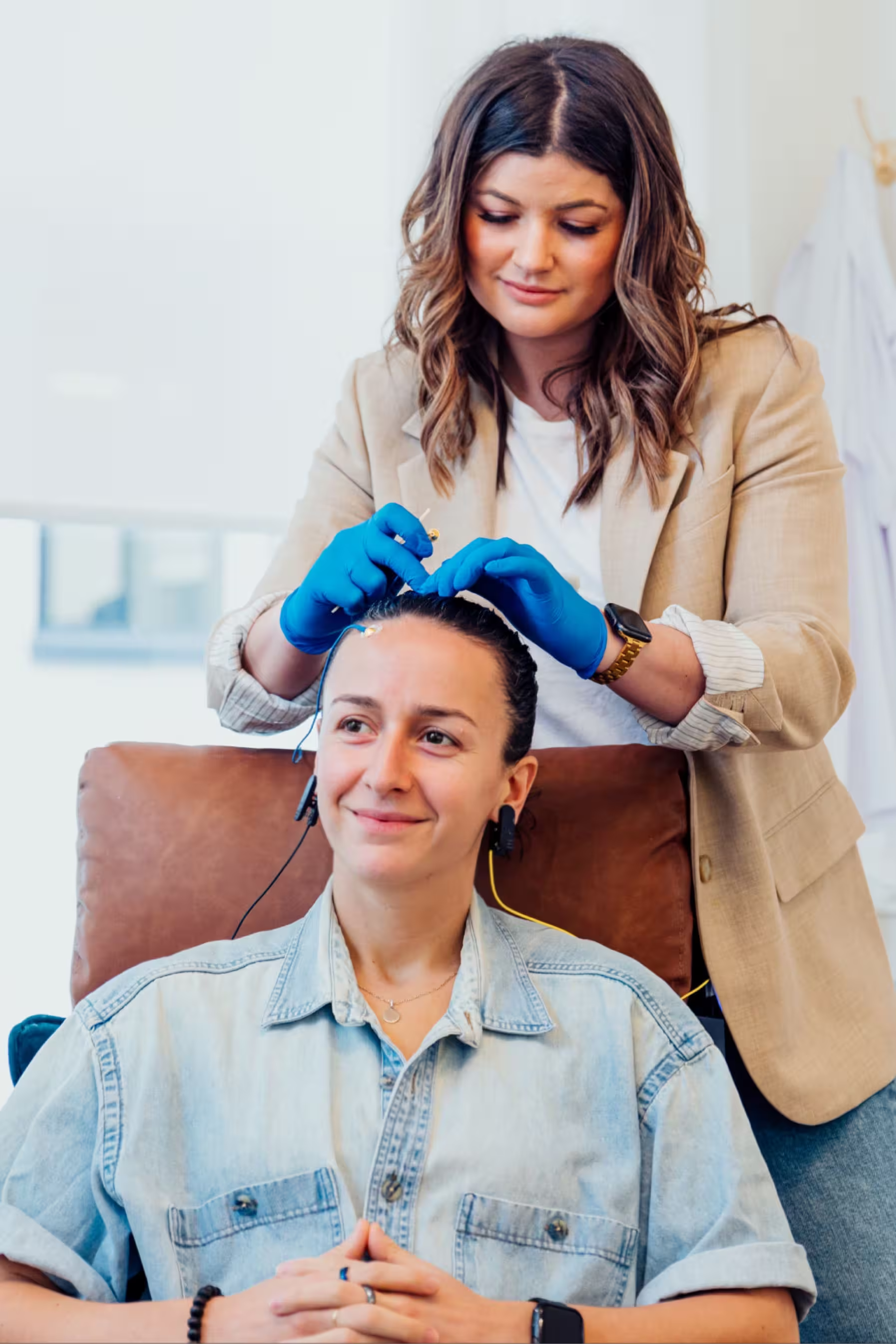
EEG Biofeedback and active neurofeedback work by monitoring the brain's electrical activity in real time and feeding that information back to you in a form the brain can respond to and learn from. Sensors placed gently on the scalp read brainwave frequencies as you engage in a task or exercise during the session. When your brain produces activity associated with a desired state, the feedback reinforces it. When it drifts toward less regulated patterns, the feedback shifts accordingly. Over repeated sessions, the brain learns to produce more efficient and balanced patterns with greater consistency, essentially training itself toward better regulation through the same mechanism of learning it uses for everything else.
Think of it as physiotherapy for the brain. Just as a muscle can be retrained toward more efficient and functional movement patterns, the brain's electrical communication networks can be retrained toward more efficient and regulated activity. The process is non-invasive, non-pharmaceutical, and grounded in the well-established neuroscience of neuroplasticity. At Providence, every neurofeedback training program is preceded by an assessment, either an interview-style clinical evaluation or a comprehensive QEEG brain mapping, so that the protocols used in your sessions are precisely targeted to your brain's specific patterns rather than a generalized approach. The result is neurofeedback that is genuinely personalized to you, not a one-size-fits-all protocol applied uniformly across clients.

A more efficiently communicating brain with improved regulation across key neural networks

Reduced anxiety and a nervous system that can return to baseline more reliably

Improved attention, focus, and the capacity to sustain cognitive effort without as much strain

Better sleep quality as the brain learns to shift more fluidly into restful states

Stabilized mood and reduced emotional reactivity and dysregulation

Meaningful symptom relief for presentations including PTSD, ADHD, depression, and chronic pain

A non-pharmaceutical option that addresses brain function rather than masking symptoms

Cumulative and lasting change that builds progressively across the course of treatment

A deeper understanding of your own brain and what it needs to function at its best
years in business
clients served
modalitie options
neurotherapy options
how therapy helps
EEG Biofeedback and active neurofeedback work by monitoring the brain's electrical activity in real time and feeding that information back to you in a form the brain can respond to and learn from. Sensors placed gently on the scalp read brainwave frequencies as you engage in a task or exercise during the session. When your brain produces activity associated with a desired state, the feedback reinforces it. When it drifts toward less regulated patterns, the feedback shifts accordingly. Over repeated sessions, the brain learns to produce more efficient and balanced patterns with greater consistency, essentially training itself toward better regulation through the same mechanism of learning it uses for everything else.
Think of it as physiotherapy for the brain. Just as a muscle can be retrained toward more efficient and functional movement patterns, the brain's electrical communication networks can be retrained toward more efficient and regulated activity. The process is non-invasive, non-pharmaceutical, and grounded in the well-established neuroscience of neuroplasticity. At Providence, every neurofeedback training program is preceded by an assessment, either an interview-style clinical evaluation or a comprehensive QEEG brain mapping, so that the protocols used in your sessions are precisely targeted to your brain's specific patterns rather than a generalized approach. The result is neurofeedback that is genuinely personalized to you, not a one-size-fits-all protocol applied uniformly across clients.

If you have any questions for us prior to booking an appointment or being matched with a therapist, please fill out this contact form and our clinic concierge will get back to you during business hours (Monday- Friday 9:00am to 5:00pm PST).
We look forward to supporting you
604-332-5279
info@providencetherapybc.com

For Your Clarity
Yes. An assessment is required before beginning EEG neurofeedback training at Providence, and this is a clinical standard we hold for good reason. Neurofeedback without proper assessment is a generalized approach that may or may not address what is actually driving your symptoms. Our assessment process, whether you choose the interview-style evaluation or the comprehensive QEEG brain mapping, ensures that your training protocols are built around your brain's specific patterns. This is what makes the difference between neurofeedback that produces meaningful change and neurofeedback that simply passes time.

You sit comfortably while sensors are attached to your scalp to monitor brainwave activity. The sensors read your brain's electrical output but do not deliver any stimulation or current to the brain. You then engage in a task or exercise, often watching a screen or listening to audio, while receiving real-time feedback that reflects what your brain is doing moment to moment. The feedback rewards the brain for moving toward targeted patterns, and the brain learns through that reward process. Sessions are generally relaxed and many clients find them enjoyable. The duration of each session varies depending on your protocol.
Neurofeedback is a training process rather than a one-session intervention, and the number of sessions required varies depending on the nature and complexity of the presenting concerns, the brain patterns identified in your assessment, and how your individual system responds to training. Some clients notice meaningful shifts within the first several sessions. Others experience more gradual change that accumulates over a longer course of treatment. Your provider will discuss realistic expectations with you based on your assessment findings and will check in on progress regularly throughout the process.
EEG neurofeedback is considered safe and non-invasive for the vast majority of people. The most commonly reported side effects are mild and temporary, including occasional fatigue or a brief sense of mental tiredness following a session, particularly in the earlier stages of training. For some clients, especially those with a history of trauma or a highly sensitized nervous system, it is not uncommon to feel temporarily more activated or unsettled before the training begins to produce a more settled baseline. This is a recognized part of the process rather than a cause for alarm, and your provider will monitor your response carefully and adjust protocols as needed.
EEG biofeedback, also called active neurofeedback, is an engaged training process in which the client participates actively through tasks and exercises while receiving feedback about their brainwave activity. LENS, or Low Energy Neurofeedback System, is a distinct approach in which a very low-power signal is delivered to the brain to interrupt stuck patterns and support reorganization, often with very brief session contact times. Both are available at Providence's Brain Bar and can be appropriate for different presentations and preferences. Your provider will help you understand which approach is the better fit based on your assessment and clinical picture.
Neurofeedback can be beneficial for a wide range of presentations including anxiety, depression, ADHD, PTSD, trauma, insomnia, chronic pain, and cognitive concerns. It is particularly valuable for those who have not found sufficient relief through talk therapy alone, those who prefer or require a non-pharmaceutical approach, and those who want to address the neurological dimensions of their symptoms directly. It can be used as a primary treatment or as a powerful adjunct to other therapeutic work. During your assessment, your provider will discuss whether neurofeedback is a strong fit for your specific situation and goals.