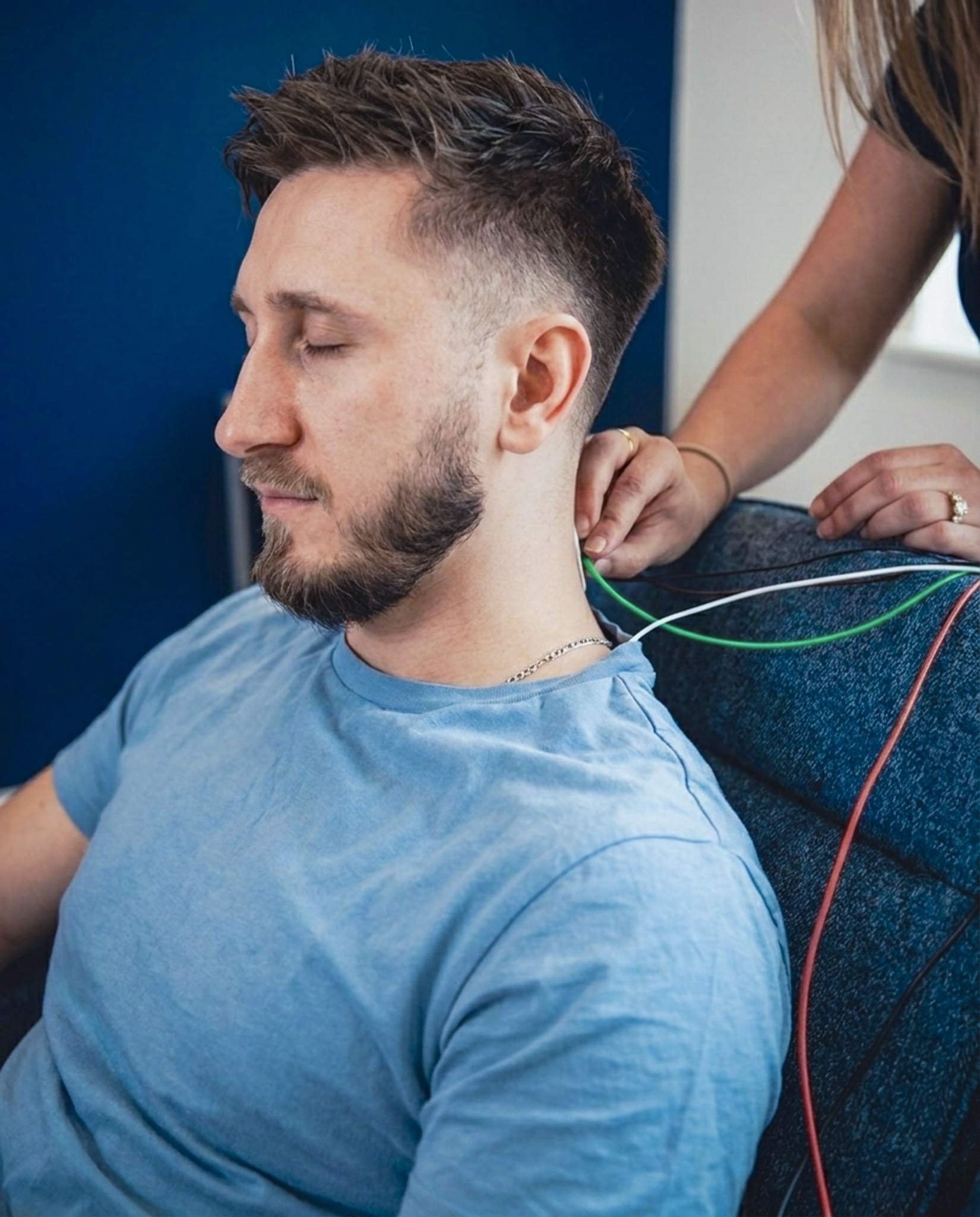
Peak Performance Enhancement

You don't have to be struggling to benefit from support. Some people come here to become exceptional. Others come to find their way back.

why you might be here

You're reaching for your ceiling, or rebuilding after it fell.

Performance isn't only about sport. It's about the executive who needs to think clearly under pressure, the artist who wants to access creative flow more reliably, the entrepreneur navigating high-stakes decisions with a nervous system that needs to stay regulated, the student who has the ability but can't get out of their own way when it counts. Peak performance work is for anyone who wants to close the gap between where they are and what they're capable of, not because something is wrong, but because potential is worth pursuing.

‍

And then there's the other side. The injury that sidelined you longer than expected. The failure that shook your confidence in ways you didn't anticipate. The burnout that arrived after years of pushing hard and finally hit a wall. The setback that made you question whether you still have what it takes. Recovery from a performance breakdown is its own kind of work, and it deserves the same seriousness and care as the pursuit of excellence that preceded it.

how therapy helps

Supporting the mind, brain, and nervous system behind the performance, and the comeback.

At Providence, we approach peak performance and performance recovery through the same integrative, brain-body lens that shapes all of our work. Sustained high performance isn't just a matter of mindset or strategy. It depends on a well-regulated nervous system, a brain that can shift fluidly between states of activation and recovery, and a psychological foundation that can hold both ambition and setback without collapsing. These are trainable. That's the premise behind everything we offer in this space.

We draw on a combination of therapeutic support and Brain Bar technologies to work with the full picture of what performance requires and what recovery demands. Neurofeedback helps train the brain toward greater focus, composure, and cognitive flexibility. Heart rate variability training builds the nervous system resilience that separates high performers who sustain from those who burn out, and supports the regulated recovery that is essential after a significant setback. Therapeutic work addresses the psychological patterns underneath performance, including perfectionism, fear of failure, identity disruption after injury or loss, impostor experience, and the grief that can accompany a fall from form. Whether you're building toward something or finding your footing again, we'll meet you where you are.

Why choose Providence Therapy

7

years in business

3,500+

clients served

34 +

modalitie options

10 +

neurotherapy options

illustration blue line-work flowers

"Excellence is not a destination you arrive at once. It is a standard you build the capacity to maintain, and the resilience to return to." — Unknown

the outcome

What Sets Us Apart

  • Unconventional by Choice, Exceptional by Design

    Our clinicians combine specialized expertise with intentionally unconventional, innovative methods to craft care that is deeply personal and never one-size-fits-all.
  • We don't just talk about it

    Our experiential, integrative treatment models address trauma and a wide range of concerns at their root.
  • Trusted by Over 3,500 Clients and Counting

    Our track record reflects thousands of individuals, couples, and families who have found meaningful healing with our team.
  • Rooted in Values, Driven by Relationship

    We believe values-based leadership creates values-based care. That relational philosophy shapes every interaction you have with our team, and you'll feel it.

the outcome

About us

What Sets Us Apart

  • Unconventional by Choice, Exceptional by Design

    Our clinicians combine specialized expertise with intentionally unconventional, innovative methods to craft care that is deeply personal and never one-size-fits-all.
  • We don't just talk about it

    Our experiential, integrative treatment models address trauma and a wide range of concerns at their root.
  • Trusted by Over 3,500 Clients and Counting

    Our track record reflects thousands of individuals, couples, and families who have found meaningful healing with our team.
  • Rooted in Values, Driven by Relationship

    We believe values-based leadership creates values-based care. That relational philosophy shapes every interaction you have with our team, and you'll feel it.

Have questions
before taking the leap?

If you have any questions for us prior to booking an appointment or being matched with a therapist, please fill out this contact form and our clinic concierge will get back to you during business hours (Monday- Friday 9:00am to 5:00pm PST).
‍
We look forward to supporting you
‍
604-332-5279
info@providencetherapybc.com

Thank you! Your submission has been received!
Oops! Something went wrong while submitting the form.
What you might walk away with

Greater mental clarity, focus, and composure under pressure

A more regulated and resilient nervous system as the foundation for sustained performance

Insight into the psychological patterns that are limiting your ceiling

Freedom from perfectionism, fear of failure, or imposter experience

A rebuilt sense of identity and confidence following a significant setback

Improved recovery, rest, and the capacity to switch off when needed

Stronger emotional regulation in high-stakes or competitive environments

Tools for accessing flow states and peak cognitive performance more reliably

A sustainable approach to excellence that doesn't come at the cost of your health

Match With A Therapist

Staff Who Offer this Service

view all team

Dr. Manj Bath

(He/Him)

R.Psych.

Licensed Psychologist, PsyD.

Dr. Aida Javadzadeh

(She/Her)

Doctor of Medicine MD

Expert Neurofeedback Provider & Brain Health Specialist

Daniel Prince

(He/Him)

MCP, RCC

Registered Clinical Counsellor

Alysha Aubin

(She/Her)

MCP, RCC

Owner /Clinical Director, Registered Counsellor, Lens Provider & Educator

Christen McCallum

(She/Her)

MA.Lead, MCP, RCC, NATC, CIMHP

Owner/Founder, Registered Clinical Counsellor, Lens Provider & Educator

Is peak performance work only for athletes?

Not at all. While performance psychology has roots in sport, the principles apply across any domain where output, pressure, and the gap between potential and delivery are relevant. We work with athletes, executives, entrepreneurs, artists, students, and anyone else who wants to perform at their best and understand what's getting in the way. If you care about what you do and want to do it better, this work is for you.

What does performance recovery actually mean?

Performance recovery refers to the process of rebuilding following a significant setback, whether that's a physical injury, a professional failure, a period of burnout, a loss of form, or any experience that has disrupted your confidence, identity, or capacity to perform. Recovery isn't simply about getting back to where you were. It's often an opportunity to understand what contributed to the breakdown in the first place and to build something more sustainable going forward. This work addresses the psychological, neurological, and nervous system dimensions of that process.

How does identity factor into performance and recovery?

For high performers, identity and performance are often deeply intertwined, sometimes to a degree that only becomes visible when performance is disrupted. An injury, a significant failure, or a period of burnout can trigger a genuine identity crisis when so much of a person's sense of self is tied to what they do and how well they do it. Therapeutic work in this space takes that seriously, helping clients develop an identity that is grounded in something more stable than performance outcomes, which paradoxically tends to support better and more sustainable performance over time.

How is this different from coaching?

Coaching and performance psychology share some territory, but they are distinct. Coaching tends to focus on goals, strategy, and accountability. Performance work at Providence goes deeper, addressing the neurological, psychological, and nervous system dimensions that shape how you think, regulate, and perform under pressure. We work with the internal architecture behind performance, not just the external plan. For some clients, therapy and coaching work well together, and we're happy to collaborate with coaches already in your corner.

Can therapy help with performance anxiety?

Yes, and it's one of the most common reasons people come to this kind of work. Performance anxiety isn't simply a mindset problem to think your way out of. It has neurological and physiological dimensions that respond well to somatic, brain-based, and trauma-informed approaches. We work with the nervous system activation underneath the anxiety, not just the thoughts that accompany it, which tends to produce more lasting results than cognitive strategies alone.

How do I get started?

A discovery call is the best place to begin. We'll take the time to understand your goals, your current situation, and what combination of therapeutic and Brain Bar support is likely to be most useful. From there, we'll build a starting point that makes sense for where you are and what you're working toward.

vancouver emdr therapy

for your clarity

About us

Frequently Asked Questions

for your clarity

About us

Frequently Asked Questions

Is peak performance work only for athletes?

Not at all. While performance psychology has roots in sport, the principles apply across any domain where output, pressure, and the gap between potential and delivery are relevant. We work with athletes, executives, entrepreneurs, artists, students, and anyone else who wants to perform at their best and understand what's getting in the way. If you care about what you do and want to do it better, this work is for you.

What does performance recovery actually mean?

Performance recovery refers to the process of rebuilding following a significant setback, whether that's a physical injury, a professional failure, a period of burnout, a loss of form, or any experience that has disrupted your confidence, identity, or capacity to perform. Recovery isn't simply about getting back to where you were. It's often an opportunity to understand what contributed to the breakdown in the first place and to build something more sustainable going forward. This work addresses the psychological, neurological, and nervous system dimensions of that process.

How does identity factor into performance and recovery?

For high performers, identity and performance are often deeply intertwined, sometimes to a degree that only becomes visible when performance is disrupted. An injury, a significant failure, or a period of burnout can trigger a genuine identity crisis when so much of a person's sense of self is tied to what they do and how well they do it. Therapeutic work in this space takes that seriously, helping clients develop an identity that is grounded in something more stable than performance outcomes, which paradoxically tends to support better and more sustainable performance over time.

How is this different from coaching?

Coaching and performance psychology share some territory, but they are distinct. Coaching tends to focus on goals, strategy, and accountability. Performance work at Providence goes deeper, addressing the neurological, psychological, and nervous system dimensions that shape how you think, regulate, and perform under pressure. We work with the internal architecture behind performance, not just the external plan. For some clients, therapy and coaching work well together, and we're happy to collaborate with coaches already in your corner.

Can therapy help with performance anxiety?

Yes, and it's one of the most common reasons people come to this kind of work. Performance anxiety isn't simply a mindset problem to think your way out of. It has neurological and physiological dimensions that respond well to somatic, brain-based, and trauma-informed approaches. We work with the nervous system activation underneath the anxiety, not just the thoughts that accompany it, which tends to produce more lasting results than cognitive strategies alone.

How do I get started?

A discovery call is the best place to begin. We'll take the time to understand your goals, your current situation, and what combination of therapeutic and Brain Bar support is likely to be most useful. From there, we'll build a starting point that makes sense for where you are and what you're working toward.

vancouver emdr therapy
couples therapy vancouver